

Startups have always won by moving faster than larger competitors. In 2026, that advantage increasingly comes from one thing: building products that do more with less manual effort. That is why AI-powered app use cases for startups are getting so much attention. AI is no longer just a “smart feature” or a chatbot bolted onto an interface. It is becoming part of how startups acquire users, improve retention, automate operations, and differentiate their product experience.
The important question is not whether startups should use AI. It is where AI actually creates value without adding unnecessary complexity. Too many early-stage teams chase AI because it sounds modern, only to end up with expensive features that do not improve the product. The better approach is practical: identify workflows where AI reduces friction, speeds up decisions, or unlocks a better user experience.
Let’s talk about the most relevant AI-powered app use cases for startups, why they matter, & how founders should think about implementation.
Why AI Matters More for Startups Than Ever
Startups often operate with limited headcount, limited time, and strong pressure to show traction quickly. AI can act as a force multiplier in that environment because it helps small teams automate repetitive work, personalize product experiences, surface insights faster, reduce support overhead, improve operational efficiency, and launch differentiated features earlier.
The biggest benefit is leverage. A startup does not need AI because it wants to “look innovative.” It needs AI when AI helps a small team perform like a larger one.
This is where strong AI development services and focused AI application development can make a difference, especially when the implementation is tied to a clear product or business outcome.
1. AI-Powered Customer Support and Help Flows
This is one of the most immediate and useful applications for startups.
Most early-stage products face the same problem: as soon as users start arriving, support volume rises faster than the team can handle. Questions repeat. Onboarding confusion leads to tickets. Simple requests consume founder or product time.
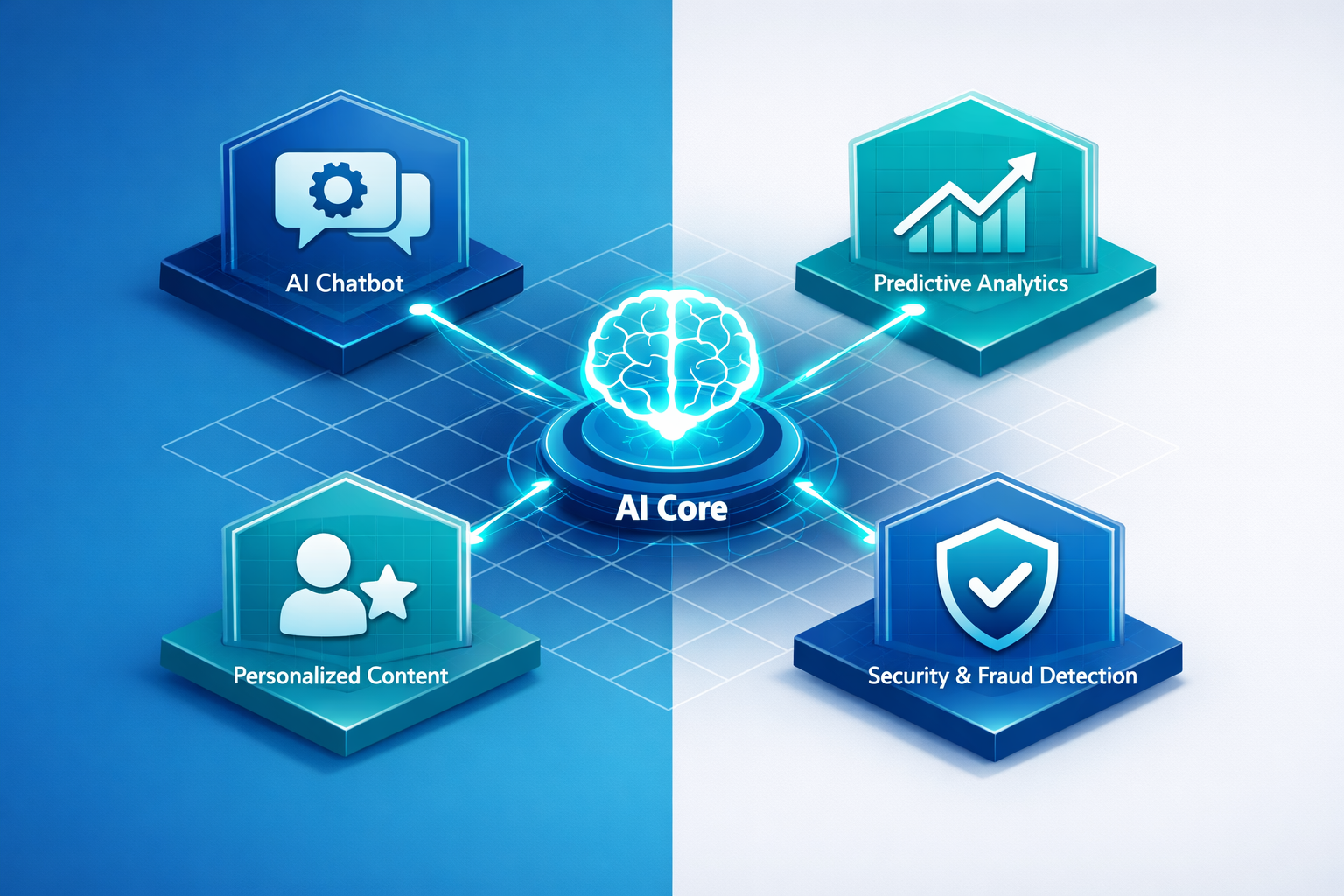
An AI-powered support layer can help with:
- Instant answers to common questions
- Onboarding guidance
- Ticket categorization and routing
- Summarization of support conversations
- Recommended responses for human agents
For startups, the advantage is not just lower support cost. It is faster response times and a smoother user experience during the stage when every retained user matters. A well-designed AI support system can also expose product friction points by showing which questions come up repeatedly.
2. Personalized Onboarding and Product Guidance
Many startups lose users in the first few sessions, not because the product is weak, but because the path to value is not obvious. AI helps by making onboarding more adaptive.
Instead of giving every user the same tour, the app can:
- Detect likely user intent
- Recommend the most relevant first action
- Adjust onboarding steps based on role or behavior
- Surface useful features at the right time
- Reduce clutter for users who do not need everything at once
This is one of the most practical AI-powered app use cases for startups because it directly affects activation and retention. If users get to value faster, growth becomes easier.
3. Intelligent Search and Knowledge Retrieval
Search is often underestimated in startup products. As data grows, users don’t want to dig through menus, tags, dashboards, or help docs. They want to ask a question and get the right answer quickly.
AI-powered search can improve:
- In-app knowledge bases
- Internal team documentation
- Product catalogs
- Customer records
- Document-heavy workflows
- Semantic search across content
For startups building productivity tools, internal platforms, fintech apps, health tools, legal tech, or SaaS products, this kind of retrieval can dramatically improve usability.
This also overlaps with enterprise application development when startups are serving business users who need fast, reliable access to structured and unstructured information.
4. Workflow Automation for Repetitive Operations
AI is especially useful when startups have repetitive operational tasks that are too frequent to stay manual but too nuanced for rigid rule-based automation alone.
Examples include:
- Invoice and receipt extraction
- Lead qualification
- Support triage
- Content moderation
- Scheduling and reminders
- Document classification
- CRM updates from conversation data
This is where AI application development becomes highly practical. Instead of asking users or employees to do repetitive work, the app handles the first pass automatically and lets people focus on exceptions.
For operations-heavy startups, this can save significant time and reduce process bottlenecks without requiring a large operations team.
5. AI Copilots for Users
One of the biggest product shifts in recent years has been the rise of the “copilot” model. Instead of forcing users to learn every feature, the product helps them complete tasks more directly.
For startup apps, that might mean:
- Generating a first draft
- Summarizing uploaded documents
- Recommending next steps
- Suggesting edits or improvements
- Helping users interpret data
- Automating setup steps
The key is that the AI should make the product easier to use, not simply add a chat box.
When done well, this creates strong differentiation. A startup can compete with larger products not by matching every feature, but by making the most important workflows much easier.
6. Predictive Analytics and Smart Recommendations
Startups increasingly rely on data to make quick decisions, but dashboards alone are often not enough. AI can help move from reporting to prediction.
Useful startup use cases include:
- Churn prediction
- Lead scoring
- Fraud or anomaly detection
- Personalized recommendations
- Revenue forecasting
- Demand prediction
- Identifying users likely to convert or expand
This matters because startups cannot afford to act too late. If AI can surface risk or opportunity earlier, teams can respond faster and more effectively.
For B2B startups in particular, predictive features often strengthen the product itself while also improving internal decision-making.
7. AI in Content and Communication Workflows
Not every startup is building a content platform, but nearly every startup communicates constantly with prospects, users, investors, candidates, and internal teams. AI can streamline that communication layer.
Relevant app-level use cases include:
- Drafting and personalizing outbound messages
- Summarizing meetings or calls
- Generating internal notes
- Writing product descriptions
- Preparing reports
- Helping users create or refine content inside the app
This is one of the most widespread areas for custom mobile app development too, especially in mobile-first products where users want to create or respond quickly without switching contexts.
8. Image, Voice, and Document Intelligence
A major shift in modern AI apps is multimodal input. Startups are no longer limited to text. Apps can now interpret photos, scanned documents, voice notes, screenshots, and even forms and PDFs.
This opens up valuable use cases such as the following:
- ID or document verification
- Expense capture
- Damage detection
- Voice-based commands
- Medical or wellness intake
- Visual search
- Product scanning and recommendations
For many founders, this is where custom mobile app development and AI intersect most naturally, because mobile devices are already the capture layer for photos, voice, and documents.
9. Internal Productivity for Startup Teams
Not every AI use case has to be customer-facing. Some of the best early wins happen internally.
Startups can use AI-powered internal tools for:
- Sales assistance
- Meeting summaries
- Hiring workflow support
- Internal search
- Contract review support
- Pipeline analysis
- Task automation across tools
These use cases may not be visible to users, but they improve execution speed across the company. For an early-stage startup, that can matter just as much as a flashy front-end AI feature.
How Startups Should Choose the Right AI Use Case
The best AI-powered app use cases for startups usually have three characteristics:
1. They solve a real bottleneck
AI should reduce a clear pain point: slow onboarding, repetitive manual work, poor discoverability, or support overload.
2. They fit the product naturally
If the AI feels bolted on, adoption will be weak. The best use cases are closely tied to the app’s core user journey.
3. They can be measured
Every AI feature should have success metrics like retention lift, faster activation, lower support volume, improved conversion, reduced manual processing time, and higher customer satisfaction. This keeps AI tied to business value instead of novelty.
Final Takeaway
The most useful AI-powered app use cases for startups are the ones that create immediate leverage – better onboarding, faster support, smarter search, stronger recommendations, cleaner workflows, and lower operational drag.
That is why AI is becoming such a meaningful part of AI development services, AI application development, and even broader enterprise application development and custom mobile app development. Startups that use AI well are not just adding features. They are redesigning how work happens inside the product and around it.
The real opportunity is not to build “an AI app.” It is to build a better app with AI placed exactly where it improves user value, team efficiency, and growth potential.